Showing posts with label tr. Show all posts

Monday, May 31, 2010

Let's celebrate!

Today I went out to San Ysidro with Theresa and Jamilah. We threw a toprope on Oranguhang, the stuff to the right and the stuff to the left of it. For me this was primarily an opportunity to test my new shoulder. It seems to have held, but we'll know for sure tomorrow. It was so nice to get out!

Thursday, April 15, 2010

Testing the TR-solo rig

Things have been quiet around here, since I re-injured my shoulder just over three weeks ago and haven't been climbing at all. I'm silently screaming in frustration.

On Saturday I ventured out, with a new climbing partner about whom I'm really excited, and checked out the Gibraltar area. We wanted to play on Lower Gibraltar, but there were people already climbing there. We checked out Gibraltar Rock, but the South face TR's were already occupied. We went up to Toxic Waste Wall, but the rock quality sketched us out -- it got badly fried in last year's fire. So we ended up at Crag Full o' BoomBoom, where Michelle led everything in style. It was chill. I TRed Tuco, and it didn't feel that great, which made me a little sad.

Yesterday I was going stir crazy dealing with work, so I decided to pop up to Lower Gibraltar and test my TR-solo system.

Before I get into my current system, here's a little about my first attempt about a month ago. I originally thought that I could TR-solo with my guide in autoblock mode + a prussik backup. I've used this setup before in low 5th class terrain (gullies) when a rope was stuck or there was some other reason why I needed to go back up to my anchor. But when I tried to use it at Lower Gibraltar, which is a reasonably steep dihedral and a steep face left of it, I realized a couple things. First of all, I shouldn't have used both strands of the rope. In fact I didn't need to, because the rope was fixed at the anchor, so I could've used just one. That was just operator error on my part. Second, since the rope obviously does not feed freely through the guide, the loop of rope that accumulates above the guide is a real problem. I kept stepping on the rope and getting tangled up. This is a problem with both a single and a double strand setup. I hadn't noticed it before on the low angle terrain, but in the steep terrain it was a definite issue. Third, the weight of the rope loop makes feeding it through the guide really hard, sometimes requiring both hands. The prussik was actually the most pleasant part of this system...

So my original plan wasn't going to work. I studied ascender devices and TR-solo resources, and decided the device I wanted to use was Petzl's microcender. I wanted a device that didn't have sharp teeth in the camming section, and that could, ideally, be used for other tasks as well, but would be primarily for TR-solo and should be bombproof for that. The microcender fit the bill, can also be used for hauling, and it weighs about half as much as the alternatives. That probably means it'll wear out twice as fast, but that remains to be seen. Note that it's not indicated for lead-solo or even TR falls with slack in the rope. I think it's meant to work best on fixed, static lines, but it seems like a lot of people use it on their regular dynamic ropes. It's a gorgeous little device, that's very simple to set up and break down.

At first my plan was to have the microcender set up on my belay loop, on one strand, and a prussik backup going to my belay loop, at eye level, either on the same strand or the other strand. When I set that up I realized that the prussik was now the annoyance in the system, because it was impacting how the rope was feeding into the microcender, and also the loop it made was flopping around, threatening to get tangled up with the microcender. I'm especially aware of the possibility of something snagging the microcender's handle and keeping it from doing its job, so having a sling flopping around in the vicinity was a definite no no.

After tying in short, setting up the system and taking a bunch of test falls on the microcender I was ready to trust it alone. I knew that the rope has to be weighted a little in order to feed through the microcender by itself, but I didn't know how much. The pitch I was climbing is only about 1/4 length of rope up, so I piled the loose rope at the bottom of the climb onto the end, hoping that the weight of half the 10mm rope would be sufficient. For the first half of the climb, it wasn't, so I had to occasionally help the rope through the device. I could do that single-handed so it wasn't a big hindrance on 5.8 terrain. For the second half of the climb the weight was enough and the rope fed through just fine. People have suggested using a quart sized water bottle as a weight, or fixing the line on the ground, both of which are great ideas if you're planning to return to the ground. I was climbing at a place where you rap down from your anchor to climb, so I wanted to be able to pull up the rope behind me with no snags.

I have come up with only one way to switch from microcender-belay to rappelling with my guide at the top of the climb (I wanted to do one more lap, so I was headed back down). That is to tie directly into the anchor, unweight and remove the microcender, then set up the guide for rap. It seems like there should be some way to go directly from the microcender to the guide, but I don't see what that is. If I set up the guide below the microcender, there is no way to remove the microcender because it's loaded (it's not like a grigri, where the lever unloads the cam). So I need a point of leverage above the microcender to load my weight onto. Setting up the guide above the microcender is obviously not an option, since my weight is on the rope. Thus it seems that the only way to switch to rapelling is to offload to a point (anchor or prussik) above the microcender, remove the microcender, then set up the rappel. Interesting...

In summary the system seems to work. I'm not entirely happy about using a single device. A possibly better setup would be to have one microcender at chest level and one at the belay loop, similar to Steph Davis' setup (except she uses mini-traxions, which have sharp teeth). On this test day I didn't really enjoy myself climbing, both because I was stressed out by all this rigging, but also because my shoulder is completely messed up. Time will tell if knowing how to set this up will enable some fun for me in the future, or whether it will prove too stressful to use regularly. They say that roped soloing is another level again in the mind game that is climbing, and I agree. My stomach was in knots both times I worked on this stuff. I don't even try something unless I've spent hours researching it and mentally working it out, and, despite that confidence that I have the principles fully in command, it's stressful to tie in for a TR-solo. We'll see how it feels next time...

Update: My friend Rick has written a blogpost, adding his observations to my thoughts on roped-soloing.

Sunday, June 28, 2009

Another weekend at Idyllwild


Slab climbing at Suicide
Originally uploaded by slampoud
This Friday and Saturday were Idyllwild climbing days. On Saturday Ben and I racked up to do Whodunit, a classic multi-pitch on Tahquitz. There is some debate as to exactly how many pitches it takes to do the climb. The guide book shows 8, and the mountainproject folks weigh in with 5. In the end it took us 6, but really 5 (you'll see why). I'll refer to the pitches as they are in the guide book, mostly because that's the only place that gives landmarks, so I'm sure what's what.

The route starts with 5.9 slab, which neither of us was up for leading first thing off the ground. We noticed that it would be easy to bypass that first pitch and the second, not terribly interesting crack pitch by climbing on broken blocks to the right of the route (properly, the start of the Swallow and the Gulp), and traversing left on a ledge to the start of the 3rd pitch of Whodunit. So we did, Ben leading that first easy pitch.

The 3rd pitch of Whodunit is the second crux: a 5.9 exit from under a roof capping a chimney. Ben led up to the start of the chimney and realized that he was running out of draws. He made a belay at the base of the chimney, so we broke the 3rd pitch into two pieces. Then he led up to the crux, where he fell on a #4 camalot placed directly under the roof. It was kind of a memorable fall, because I heard him scrabbling, a bit like a cat that jumps onto something and misses, before I felt his weight on the rope. He then aided past the crux and made it out. I followed and cleaned the pitch free, which I was very proud of. In fact, I was doubly proud because I had to do the first half, the chimney, with the camelback pack on my chest, then stop under the roof and switch it around to my back to get around the roof. And somehow I did not fall during all this.

I led the next pitch, which, in hindsight, was the 4th plus half of the 5th pitch by the book, up to a cracked roof. The freakiest part was about a quarter up the nominal 5th pitch. By then I'd climbed up an off-width (right off the belay, where I didn't have the #4, so I sent a rope down for it), traversed right to another crack, and then come to a headwall. There was a big block in front of the headwall, about human sized, and I had a small cam on one side of it. I was deciding which side of it to go in order to go up the headwall, when I realized that human-sized block was free-standing and not well lodged, at that. I almost freaked! My pro depended on it, and I was bear-hugging it when I realized there was nothing around the back, it didn't connect to the headwall. Man! That was bad. I very gingerly switched from the left to the right of the block and found a placement on the headwall, before, again very gingerly, stepping on the free standing block to gain the headwall. I climbed 20 more feet and made a hanging belay with one good and two tipped out cams under the broken roof. I was very unhappy and uncomfortable. The pitch behind me (rated 5.8) had been very emotional and the belay was exceedingly uncomfortable.

Ben had the next pitch, but it wasn't entirely clear which way to go. I suspect we were supposed to jog right to some easy ramps, but after much hesitation, Ben avoided the off-width directly in front of him, and went for some face climbing immediately left of that. He had to aid past that section, and then he continued up for a while. I followed that pitch free to a good belay.

The next pitch was mine, and I was terrified by the way it looked. I had to make it up to a roof, traverse under it and go up a headwall to its right. I went up and spent tons and tons of time contemplating the way to protect it, the way to make the moves, the way to minimize drag. In the end, I'm confident I did most of those things right, but it took me a while. I then followed a shallow crack up to yet another headwall type thing, which I had to yard on my arms to get over, and ended the pitch 10 feet below the summit, with hellish drag, but on a nice comfortable ledge. Ben came up and proceeded up to the summit, claiming those 10 feet as an additional pitch. I refuse to accept this!

We came down the slab descent, doing a post-mortem of the whole climb. It had taken us 6.5 hrs to do 6 pitches, 2 of which were half-pitches. That was woefully slow. I had done everything clean, but Ben had aided through one spot we knew to be a crux, and a second spot where we suspect we went straight when the rated route circumvented it. I was happy with my placements during the climbing, but unhappy with one of my anchors. Ben had overcome the desire to give up at least once. Overall, the climb had felt like it was teetering on the verge of being an epic, but it never became one. It wasn't done in great style, but it was done and done safely, and it was our hardest multipitch together yet. And we both agreed that were we to get on it again, we'd be able to style it in sub-1 hour per pitch no problem.

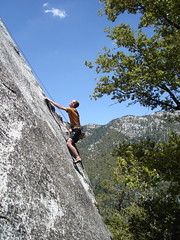
The next day we were both feeling pretty accomplished and lazy, so we went looking for the Smooth Soles wall on Suicide Rock. Once there, we lounged around a while, reading about the climbing history of Tahquitz and Suicide in the book, and then we both toproped the leftmost route, Last Dance, a beautiful 10a slab to thin fingers back to slab, and Ben toproped a 10d slab called Blown Out.

Monday, June 8, 2009

Weekend at Idyllwild


Suicide rock from Tahquitz
Originally uploaded by slampoud
This weekend we met up with Emily and Sam at Idyllwild and climbed at Tahquitz on Saturday and Suicide Rock on Sunday.

On Saturday we got on Angel's Fright. As we were racking up at the base, a Canadian guy came by and, after chatting for a little while, we gathered he was planning to rope-solo something in the area. Sam proposed inviting him to join us instead, so Ben and I picked him up. Ben led pitches 1, 2 (the crux) and 4, while I led pitch 3. It was cold, windy and cloudy. Climbing was hard, but belaying was even worse. The pitch I led went really really slowly, even though it was ridiculously easy. I way overprotected it, I think because I felt insecure from being cold and stiff. Standing on lunch ledge and belaying Ben up to the 4th pitch was one of the most miserable moments climbing I've ever had. I was in full-body shiver mode. After descending we gave up for the day and went out for Mexican food.


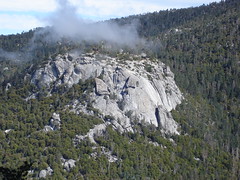
On Sunday we headed to Suicide Rock. Emily, Sam and Bert (the Canadian guy who joined us) headed up some 5.6 thing, while Ben and I explored. I really really wanted to do the 5.10a starting moves of the Breeze, but I got on it and chickened out because of the dire consequences if I fell. We moved right and I led the Shadow, a 5.8R, instead. That was definitely the hardest lead I've done on gear so far (the exception being the 5.9 Baby Robbins crack, which is only 25ft tall), and a real mental challenge. The climbing was tricky, but not that difficult. But, as the R betrays, there was a real runout section, and the crux was several feet above the last pro. The only way I could manage was to mentally break the lead down into lots of small sections, and take advantage of the bomber stances in-between to rest my mind. Ben followed, and then we came down and he did a problem to the right of Shadow, while I conserved my energy to send the Breeze on toprope. I made it to the bolt without falling, which means, had I been on lead, I would have been ok. But then again, it's hard to know whether having all the extra pro on my harness would have been detrimental to my stability. Then I fell once on the crux move above the bolt. It was fun to work the hard move, and I was rewarded by an awesome easy chimney section in the second half of the route.

All in all, a successful and educational weekend. I pushed my gear grade a bit, and I learned a little about what cold does to my leading ability.

Monday, June 1, 2009

Getting to know the local crag: Mission Gorge

This past Sunday was "getting to know the local crag" day for me. Simone, a fantabulous and super smooth local climber, took me and my gym partner of late, Julio, to Mission Gorge to show us around. Julio had never climbed outside before, and I'd scared off his previous climbing partner when I took him outside. I, on the other hand, had been to Mission Gorge only twice before, once with Julio's previous partner and once with Ben, so I still had (have, really) a lot to learn about the Gorge. We played around the leftmost end of the main wall, always on topropes, and mostly on harder stuff than I would have elected to get on had I been on my own.

I very inelegantly groveled up Knob Job (or Nob Job, depending on which guide you look at), which I hated. Simone said it was the climb that got her hooked, so now I'm waiting to find out what kind of pervert she really is. Then we got on Rock on (the right variation in the dihedral), which is Simone's favorite. Perhaps I should not say "we", since Julio and I only managed to flail and get about two feet off the ground on this 10c. We then did Suzie's wild ride, Hangman, and Crack of dust. I would have liked to have tried Mariah, but after seeing someone even taller than me struggle on it, I think maybe it's a good thing I didn't. All in all, I'd say it was a good day, except that Rock On really munged the backs of my hands, so now I'm hurtin'.

Monday, April 27, 2009

New Jack City

On Saturday I got together with the San Diego Climbers meetup buddies that I usually climb with indoors, and we headed out to New Jack City, a sport climbing field just North of Barstow. The current issue of Ice & Rock (which, by the way, I've really enjoyed) has an article about Owen's River Gorge in which it calls New Jack City a "chosspile". So I had my reservations, but I wanted to see the place for myself.

On Friday I'd sprained my right index and middle fingers by wrenching them upwards from a twisty two-finger pocket towards another hold, which I was trying to deadpoint. I think it's a pretty serious sprain, especially for my index finger, but I hope that if I take things easy, maybe focus on aerobics and yoga for the next week, I should be able to start crimping with those fingers again soon. In any case, I decided to go to NJC on Saturday anyway, after refreshing my knowledge of the so-called "buddy taping" technique which I'd used heavily as a volleyball player in the past.

I climbed a total of 6 climbs, of which I led 4. The hardest lead was a 5.9, which was a real challenge with two bad fingers. The two toprope routes were "step across", a soft 10a, and "route 66", which is harder than its rated 9 at the end, in my opinion. The grades on the routes I led were reasonably fair, I thought. As for the choss issue, I see what the author of the Owens article meant, but I don't think it's relevant. Yes, the edges of the rock break off quite a bit. It's some sort of metamorphic rock that used to be sandstone, and it breaks into little sharp-angled pieces. Nevertheless, none of the bolts seem to be suspect at all. They're all in large solid spots. So, OK, you're occasionally raining little bits of rock on your belayer. So what? Everyone knows to wear helmets around there. On the other hand, I'd sooner fall on any of these bolts rather than the ones in Santa Barbara sandstone. So, yeah, it's not Owen's, but it's not bad, either. You can get as much climbing as you'd get in the gym, and you get to be outside.

Wednesday, April 22, 2009

Around the Kern -- Saturday -- F.A.s?

On Saturday Ben and I fooled around half the day running up and down boulders on the side of the road by the Kern. It was fun, but it was getting hot and we weren't getting any climbing done. On our way to find a shady spot for lunch I spotted a couple of cracks in a small buttress below the road, a few miles before Johnsondale. Here's the map of the spot. There's a pullout on the left of the road, and the buttress is down the cliff towards the creek from there.


View Larger Map


We had some lunch, grabbed our gear and headed down. The approach was a sandy, chossy, bushy mess, and full of trash. Apparently people drive up to the pullout above and trundle all sorts of stuff down towards the creek. We saw rusty metal, tires, lots of broken glass. To be honest, I was a little concerned about the possibility of someone trundling a fridge or something right at us!

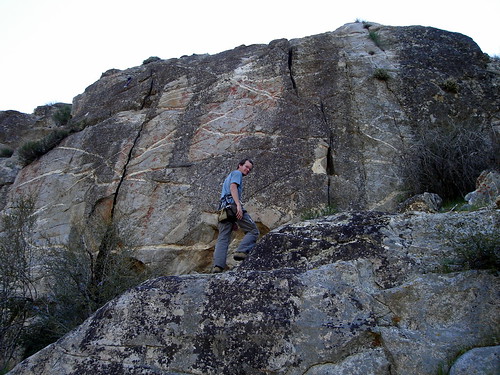
We got to the cracks, and my suspicion was confirmed: they were definitely climb-worthy. Here's a picture.


The rock was reasonably good, but it was absolutely covered in lichen. In addition, there were chockstones in the cracks, and a lot of loose rock lying around. There were absolutely no signs that a human had climbed these cracks, or indeed ever stood where we were. No chalk on the rock, no evidence of cleaning, no trails, no nothing.

We decided it would be too risky to try to climb these on lead, since the lichen made it unlikely cams would hold, and in any case the quality of the rock was a complete unknown. So we went to the top of the little buttress to set a toprope on the right-hand crack first. We chose the most enormous of several boulders up top and wrapped it with a 30-foot long webbing I always carry. While up there we trundled those rocks that posed a danger while on toprope. We also decided the belayer would have to be well off to the side of the climber, just in case, for both cracks.

Ben was kind enough to give me the first and easier ascent of the crack on the right. I trundled the first chockstone I came upon because it was obviously loose, and left the second one where it was, completely avoiding it. The climb was fun, with a couple off-width sections, one of which could be avoided by doing a mantle. The lichen, on the other hand, was insane! Smearing was, of course, impossible. Jamming was questionable. My eyes were full of ground-up lichen. Man! Suffering! I enjoyed my dirty, groveling first ascent, and Ben jumped on it. He huffed and puffed and went into the off-width rather than mantel. If indeed I have naming rights, I'd like to call the climb "at last, I made you gasp".

We then decided to shift the rope slightly left and try the face between the cracks before proceeding even further left to the harder crack. I didn't think it would be possible at all, because all the lichen made friction nonexistent, but Ben managed to squeeze a few impressive moves out of it. He then made for a right hand jug, and the jug proceeded to come completely off. Ben avoided getting hit, and the rock embedded itself in the dirt at the base of the climb. Realizing there was another small loose piece, Ben lowered off and we called that route off-limits.


When we went up to shift the anchors for the harder crack, we realized this anchor was going to be considerably trickier than the one for "at last...". For one thing, we needed to trundle a lot of rocks. But also, the only reliable boulder we could wrap was enormous, so we needed to use one of our climbing ropes. Then there was a sharp edge that the anchor rope would have to go over, and, of course, we didn't want to sacrifice a good long rope for one damn crack FA. I suggested redirecting the strong point a little to the side of the sharp section with some well-placed cams, but Ben took it further and devised an anchor at the very top of the crack with three cams. We rigged a way to lower him so he could build that, and then went below to climb.

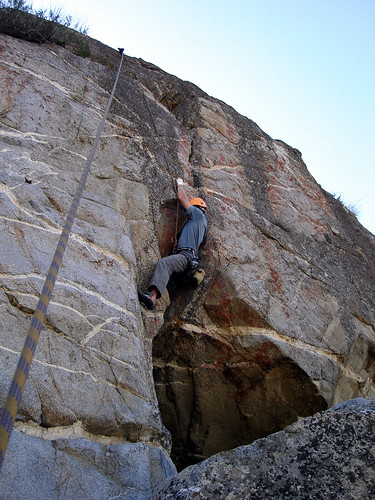
This second crack was just as dirty as the previous, but also a lot harder. The start was from a little cave with two chockstones, one razor-sharp, up to the crack proper. Here's Ben doing it.


Then I did it, huffing and puffing and cursing, but, miraculously, not falling. Ben decided to call it "seven fingered sloth", in honor of the tape gloves he borrowed from me, which had come unstuck in an interesting seven finger pattern.

After that we messed about for a while looking for other things to climb, I lowered Ben to retrieve the anchor for "sloth", and we headed back up to the car. It's impossible to be sure, but I think we may have been the first people to climb there.